

Shark Tank Metrics -Analysis

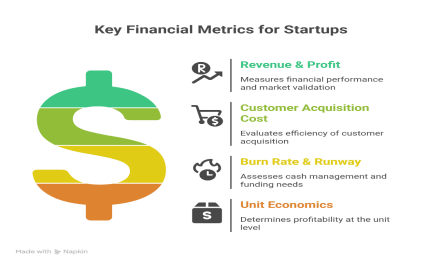
1. Revenue & Profit
Formulas
Particulars Formulas | |
Revenue | Price per Unit × Number of Units Sold |
Gross Margin | (Revenue – Cost of Goods Sold) ÷ Revenue × 100 |
Net Profit Margin | Net Profit ÷ Revenue × 100 |
EBITDA | Net Profit + Interest + Taxes + Depreciation + Amortization |

E.g. Hammer Lifestyle, a profitable D2C electronics brand with monthly revenue of ₹70–75 lakhs and ~40% margins, pitched at a ₹10 crore valuation.
Despite strong revenue and profits, concerns about brand
uniqueness led Aman Gupta to invest ₹1 crore for 40% equity,
valuing the company at ₹2.5 crore. The deal showed that even
with good financials, valuation depends on long-term positioning
and perceived business risk.
Fiscal Year Ending Revenue EBITDA Net Profit | |||
FY 2021–22 | ₹32.65 Cr | ₹0.23 Cr | ₹0.06 Cr |
FY 2022–23 | ₹24.4 Cr | ₹0.94 Cr | ₹0.75 Cr |
FY 2023–24 | ₹37.5 Cr | ₹0.88 Cr | ₹0.56 Cr |
2. Customer Acquisition Cost (CAC)
Customer Acquisition Cost (CAC) refers to the total cost spent on acquiring a single paying customer, including marketing, sales, and promotional expenses. Sharks closely look at CAC in relation to Lifetime Value (LTV), conversion rates, and marketing spend to assess how efficiently a startup grows. A high CAC with low returns signals poor scalability or unsustainable growth, whereas a low CAC with high LTV reflects a strong, profitable customer base. These metrics help Sharks determine whether the business can scale without burning excessive capital.
Formulas
Particulars Formulas | |
CAC | Total Sales & Marketing Expenses ÷ Number of New Customers Acquired |
LTV | Average Order Value × Purchase Frequency × Average Customer Lifespan |
Conversion Rate | (Number of Conversions ÷ Total Visitors or Leads) × 100 |

E.g. Snitch, a men’s fashion D2C brand, showcased strong monthly
revenue (~₹4 crore), a low CAC, and high customer retention. These
efficient acquisition metrics impressed the Sharks, though most felt the
₹300 crore valuation was too high. Aman Gupta offered ₹1.5 crore for
1.5% equity, valuing it at ₹100 crore—highlighting how a strong CAC-LTV
ratio can justify a premium, but valuation still depends on overall market
perception.
Fiscal Year Ending CAC LTV Conversion Rate | |||
FY 2021–22 | ₹ 8.5 L | ₹ 34 L | 1.8% |
FY 2022–23 | ₹ 9.2 L | ₹ 37 L | 2.1% |
FY 2023–24 | ₹ 7.8 L | ₹ 42 L | 2.6% |
3. Burn Rate & Runway
Burn Rate refers to the amount of cash a startup spends each month, while Runway indicates how many months the startup can continue operating before it runs out of funds. Sharks use these metrics to assess how efficiently a startup manages its cash and how soon it will need additional funding. A high burn rate with short runway is a red flag unless justified by rapid growth or product development. These metrics help Sharks judge financial discipline, risk level, and urgency of investment needs.
Formulas: –
Particulars Formulas | |
Gross Burn Rate (before revenue): | Total Monthly Operating Expenses |
Net Burn Rate (after revenue): | Monthly Operating Expenses – Monthly Revenue |
Runway (in months) | Cash in Bank ÷ Net Burn Rate |
 E.g. Recode Studios, a D2C cosmetics brand with ₹15 crore annual
sales, had a high burn rate due to aggressive marketing. Despite
concerns about cash flow and sustainability, their plan to reduce burn
and improve efficiency convinced Namita and Vineeta to invest ₹1 crore
for 5% equity. The deal highlighted how burn rate is acceptable if there’s a clear strategy to control it and achieve profitability.
Fiscal Year Ending Gros Burn Rate (₹ Net Burn Rate (₹ Runway (in months) Lakhs/month) Lakhs/month) | |||
FY 2021–22 | ₹ 45 L | ₹ 28 L | 12 |
FY 2022–23 | ₹ 52 L | ₹ 24 L | 15 |
FY 2023–24 | ₹ 48 L | ₹ 18 L | 20 |
4. Unit Economics
Unit economics refers to the direct revenues and costs associated with a single unit of product or service sold. Sharks analyse metrics like cost per unit, selling price, gross margin per unit, and contribution margin to assess whether the business makes money at the unit level. Positive unit economics indicate a scalable and sustainable model, while negative unit economics signal losses that may worsen with growth. This helps Sharks evaluate the viability of the business, especially in high-volume or low-margin industries.
Formula
Particulars Formulas | |
Cost Per Unit | Total Cost of Production ÷ Number of Units Produced |
Selling Price Per Unit | Revenue ÷ Units Sold |
Gross Margin Per Unit | Selling Price Per Unit – Cost Per Unit |
Contribution Margin (CM) | Selling Price Per Unit – Variable Cost Per Unit |
Variable Cost Per Unit is the cost incurred to produce and deliver one unit of a product, which changes based on the quantity produced.
Example (Hoovu Fresh): For each puja flower packet, Hoovu Fresh might spend ₹3 on sourcing flowers, ₹1 on packaging, and ₹1 on logistics—making the variable cost per unit ₹5. If they sell 10,000 packets, the total variable cost becomes ₹50,000, but the cost per packet remains ₹5.

E.g. Hoovu Fresh, a startup selling fresh puja flowers, asked for ₹80 lakhs for 1% equity. Their pitch stood out due to strong unit economics—they sourced flowers for ₹2–3 and sold them for ₹10–15, with efficient supply chain management and
minimal wastage. The contribution margin was healthy, and the founders explained how unit-level profitability was maintained even while scaling.
Impressed by their grasp of costs and margins, Aman and Piyush invested ₹1 crore for 2% equity, showing how solid unit economics can justify premium valuations and attract multiple investors.
Cost Component Amount (₹) Nature (VC/FC) Why it is VC/FC | |||
Raw Material | 3.00 | Variable Cost | Directly changes per packet |
Packaging Material | 1.00 | Variable Cost | More packets → more packets used |
Processing & Sorting | 1.50 | Variable Cost | Labour tied to number of units |
Cold Storage & Handling | 0.80 | Mixed Cost | Cold room rent = fixed; handling = variable |
Delivery & Logistics | 0.70 | Variable Cost | Cost charged per unit delivered |